

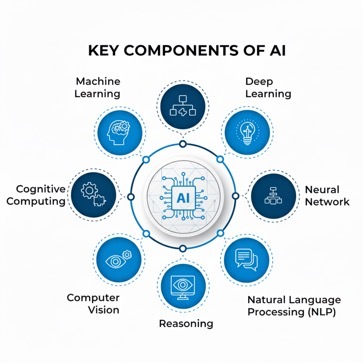
Artificial intelligence has moved from science fiction to business reality. For leaders in energy and process industries, understanding AI fundamentals isn't about becoming a data scientist, it's about making informed decisions about which technologies can solve real operational challenges.

What is artificial intelligence, really?
At its core, AI is software that performs tasks normally requiring human intelligence: recognizing patterns, making decisions, solving problems, and learning from experience. But the AI powering email spam filters is fundamentally different from AI that reasons through complex safety scenarios. Understanding these differences matters when evaluating AI for industrial use.
The three types of AI that matter
- Narrow AI excels at specific, well-defined tasks, such as identifying equipment anomalies, extracting information from documents, predicting maintenance needs, or optimizing process parameters. It can't transfer knowledge between tasks, for instance: an AI trained to analyze pumps can't suddenly analyze compressors without retraining. This is where practical value exists today.
- General AI would match human cognitive abilities across all domains. We're decades away from this, making it interesting for long-term strategy but irrelevant for current technology decisions.
- Specialized AI sits between narrow and general: systems combining multiple AI capabilities to handle complex problems within specific domains, like process safety, medical diagnosis, or legal analysis. This is where AI becomes transformative for complex operational challenges.
How AI actually works
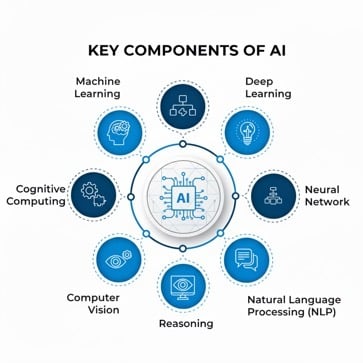
- Machine Learning teaches through examples rather than explicit programming. Feed a system thousands of examples, it identifies patterns, then applies those patterns to new situations. Show it 10,000 images each of corroded and healthy pipes, and it learns to flag potential corrosion in new inspection photos. The catch: it needs lots of quality data. "Garbage in, garbage out" applies especially to machine learning.
- Deep Learning uses neural networks, meaning computational structures loosely inspired by the human brain, in order to find complex patterns in unstructured data like images or lengthy documents. Industrial applications include visual equipment inspection from drone footage, predicting failures from maintenance records, and understanding technical documentation. The limitation: it requires massive data and computing power.
- Natural Language Processing enables AI to read, understand, and generate human language. It can extract equipment specifications from P&IDs, summarize incident reports, search decades of operational documentation, and generate structured safety reports. The challenge: understanding technical context and nuance still requires domain-specific training.
- Reasoning Models represent the newest advancement: AI designed to break complex problems into steps, evaluate options, and explain logic. This matters for safety-critical decisions requiring more than pattern matching – they need auditable, logical reasoning. Analyzing HAZOP scenarios requires one to understand cause-and-effect chains and reasoning through cascading consequences, not just pattern recognition.
What makes AI "intelligent"?
AI demonstrates intelligence through pattern recognition (detecting equipment degradation before failure), prediction (forecasting when maintenance is needed), optimization (finding the best solutions among many options), reasoning (working through multi-step problems logically), and learning (improving through experience).
Three common misconceptions
- AI is magic. The reality is that AI is advanced pattern recognition and statistical modeling. It finds relationships humans might miss due to volume or complexity, not mystical capabilities. Choose AI for problems with clear patterns and adequate data.
- AI will replace experts. Valuable AI enhances human expertise, by handling data-intensive, repetitive work, freeing experts for judgment and strategy. We should plan for human-AI collaboration, not automation of expertise.
- More complex AI is always better. Simpler AI solving specific problems often delivers more value. A focused model reducing HAZOP time by 60% beats a general-purpose model promising everything but delivering marginal improvements. Match AI complexity to problem complexity.
What to look for when evaluating AI
- Explainability: Can the system explain its conclusions? For safety-critical applications, "trust the AI" isn't acceptable. You need traceable reasoning.
- Domain knowledge: Is it trained on your industry's standards, regulations, and best practices, or generic data?
- Integration capability: Will it work with existing systems, such as P&ID software, maintenance databases, control systems?
- Learning mechanism: Does it improve as you use it, learning from your facilities and experts?
- Reliability: Does it produce consistent, measurable, high quality results?
When does it make sense to use AI?
AI excels at problems that are data-rich (sufficient examples exist), repetitive (same analysis performed frequently), complex but structured (clear logical steps exist), time-consuming (valuable if accelerated), and consistency-critical (benefit from eliminating variability).
AI struggles with novel reasoning (situations unlike training data), political intelligence (navigating organizational dynamics), physical intuition (hands-on experience understanding), and ethical judgment (competing values and stakeholder interests).
The next step
Understanding AI fundamentals enables better questions: Not "Should we use AI?" but "Which problems can AI solve better than current approaches?" Not "Will AI replace our engineers?" but "How can AI amplify our engineering expertise?" Not "What's the latest AI trend?" but "Which AI capabilities address our specific operational challenges?"
The energy and process industries face a period where AI moves from experimental to operational necessity. Organizations understanding the fundamentals, namely what AI can and can't do, what it requires, and how to evaluate it critically, will make better technology investments and achieve better outcomes. The goal isn't artificial intelligence for its own sake. It's using AI as a tool to solve real problems: making facilities safer, operations more efficient, and institutional knowledge more durable as experienced professionals retire.