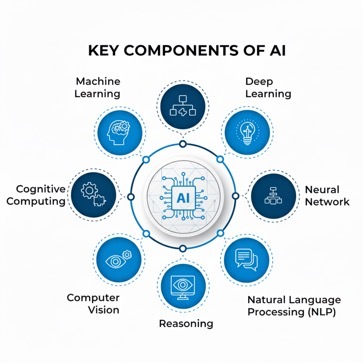


The energy and process industries are experiencing an AI transformation. But separating genuine value from vendor hype requires understanding of which AI applications can solve real operational problems versus those who simply automate things already working fine.

Why AI matters differently in process industries
Consumer AI suggests restaurants or writes marketing material. The mistakes are minor, if it’s bad, you try a different restaurant next time. Process industry AI supports decisions where mistakes can lead to catastrophic safety incidents, millions in lost production, environmental damage, regulatory violations, or lives at risk. This fundamental difference shapes everything about industrial AI.
What makes industrial AI different
- Safety-critical decision support: Industrial AI provides analysis and recommendations that human experts evaluate and act on. Accountability remains with people who understand operational context and potential consequences.
- Explainability is non-negotiable: "The AI recommended it" doesn't satisfy regulators or auditors. Industrial AI must explain its reasoning: what data it considered, what logic it applied, how it reached its conclusions.
- Domain expertise embedded: Generic AI doesn't understand that "FCV-101" is a flow control valve, what "API 521" specifies, or why certain conditions create hazards. Industrial AI requires deep domain knowledge: industry standards, process engineering principles, regulatory requirements.
- Integration with legacy systems: Process facilities operate 30+ years. AI must work with existing P&ID software, control systems, and operational tools, not require wholesale replacement.
- Data reality: Unlike consumer AI with billions of data points, industrial AI works with limited, expensive-to-generate data. It must deliver value with smaller, higher-quality datasets.
Where DOES AI deliver value?
Process safety management
- HAZOP studies
- Control room operations
- Knowledge retention
- Clear objectives: "Improve safety" is too vague. "Reduce HAZOP study time by 50% while maintaining quality" is actionable.
- Data readiness: Quality data has to be accessible, well-structured, and accurately labeled. This often requires upfront investment.
- Domain expertise: Success involves either specialized industrial AI providers or significant internal expertise to customize general tools.
- Change management: AI changes workflows. Success requires training, communication, and addressing concerns honestly.
- Validation: Before AI-generated studies inform regulatory submissions or influence operational decisions, robust validation is needed.
Traditional HAZOPs takes weeks: teams systematically analyze every process node, apply guide words to identify deviations, and document consequences and safeguards. AI-powered HAZOP assistance automates scenario generation, analyzes consequence chains, suggests safeguards based on standards and past studies, and produces structured documentation. Organizations report 60-70% time reduction while maintaining analytical quality, accelerating tedious parts so experts focus on evaluation and judgment.
Operators manage hundreds of parameters and dozens of alarms, especially during abnormal situations when cognitive load is highest. AI provides pattern recognition for abnormal situations, situational management (why parameters deviate, what could happen, what to do), and connection to HAZOP analysis. The value: not replacing operator judgment, but providing better information faster when it matters most.
As experienced safety professionals retire, decades of wisdom often walks out the door. AI captures historical incident patterns, expert decision rationale, and facility-specific operational context. New engineers can access reasoning of experienced predecessors. Safety knowledge becomes organizational rather than personal.
Predictive maintenance
Equipment failures cost money and create safety risks. AI analyzes sensor data, vibration patterns, and operating conditions to predict failures before they occur. Traditional systems trigger when parameters exceed thresholds. AI recognizes patterns preceding failures, even when individual parameters remain within normal ranges. Planned maintenance costs less than emergency repairs, and avoiding unplanned shutdowns preserves production.
Operational optimization
Process facilities operate within complex constraints: production targets, energy costs, equipment limitations, quality specs, environmental limits, safety boundaries. AI explores this multidimensional space to find optimal operating conditions. Not because it's smarter, but because it evaluates thousands of parameter combinations faster. This is most valuable in steady-state operations with well-understood processes.
Anomaly detection
Process facilities generate massive sensor data. Humans can't monitor everything continuously, meaning subtle anomalies indicating developing problems can go unnoticed until they become significant. AI continuously analyzes process data to identify unusual patterns, for instance equipment deviating from normal, process interactions suggesting problems, operational scenarios historically preceding incidents. This isn't replacing control systems, it's an additional layer catching slow-developing issues.
Document intelligence
Finding relevant information across decades of documentation – during troubleshooting, modification planning, or incident investigation – can take hours or even days. AI-powered document intelligence extracts structured data from technical drawings, searches decades of documentation using natural language, connects related information across document types, and summarizes findings from lengthy reports. Information exists but is effectively inaccessible, while AI can make institutional knowledge searchable and usable.
What success requires
AI investment makes sense when:
- the problem is significant, for instance costs meaningful time, money, or creates safety risks
- the solution is measurable i.e. you can quantify and verify improvement
- adequate data exists
- the alternative is expensive, for instance current approaches are time-intensive or error-prone
- the impact compounds, meaning value increases as the system learns
Looking forward
The question isn't whether or not we should use AI, but rather "Where does AI solve problems better than current approaches, and how do we implement it successfully?" Leading operators find answers in targeted, high-value applications: accelerating safety analysis, preserving institutional knowledge, predicting equipment failures, optimizing operations, and supporting operators during critical situations.
The goal isn't adopting AI for its own sake, it's using advanced technology to make facilities safer, operations more efficient, and organizational knowledge more durable.